The thing we already half-knew.
The Harvard Study of Adult Development tracked hundreds of people for over eighty years. The single clearest finding: the quality of your close relationships predicts your health, your cognitive sharpness, and your happiness in old age — better than wealth, career, or how much you exercise.2
Vaillant, G. Triumphs of Experience · 2012A meta-analysis of 148 studies found that people with stronger social relationships have a 50% increased likelihood of survival over a given period — comparable in magnitude to quitting smoking, and greater than the effects of obesity or physical inactivity.1
Holt-Lunstad et al. · PLoS Medicine · 2010And yet — the average American spends about 40 minutes a day alone with friends, down from 60 in the 1990s. The number of close friendships people report has dropped sharply, and roughly 1 in 8 adults report having no close friends at all.3
Survey Center on American Life · 2021 · ATUS · 2023One quiet prompt. Less than two minutes.
The home screen gives you one thing: a quiet prompt to begin. There’s no feed, no inbox, no stream of other people’s activity. Just a single daily act — a text, a check-in, a memory shared, a specific plan made.
Research on implementation intentions shows that specificity is the difference between caring deeply about your friendships and actually doing something about it.4 The ritual provides the specificity.
Six kinds of small thing.
The acts in Eddie’s Friends aren’t invented. They come from Oswald, Clark & Kelly’s 2004 framework5— one of the most rigorously validated models of adult friendship maintenance — and Fehr’s work on shared activities.6When you complete an act, you’re practicing the exact things that friendship science says work.
Check-ins
Brief, specific contact that signals "I'm thinking of you" — without requiring a long reply.
Honest expressions
Small disclosures that build trust over time. Naming what you feel, what you noticed, what you appreciate.
Unsolicited gestures
A gift, a card, a forwarded article — the small unprompted things that say you were thought of.
Specific plans
Not "we should hang out sometime." A real time, a real place, a real proposal — the lever for actual time together.
Showing up when it's hard
Making contact in difficult moments — illness, loss, rough weeks. The acts that disproportionately deepen friendships.
Shared activities
Doing one ordinary thing together. Fehr's research finds shared time itself is a primary driver of closeness.
A picture of how you show up.
After five intentional acts, your first dimension unlocks. Then one every five acts, across twenty-five total. The profile is built from what you actually do — not a quiz you fill out in five minutes — and it’s relative to you, not benchmarked against anyone else. The goal isn’t a high score. It’s a clear picture.
Who you’ve tended. Who’s overdue.
After seven intentional acts, Your Circle unlocks: every friend you’ve reached out to, sorted by how long it’s been since your last act. Most stale at the top. No algorithm. No ranking. Just the honest view of where you’ve been showing up — and where you’ve quietly gone absent.
A different kind of accountability — not toward a score, but toward specific people you already care about.
What we left out on purpose.
You come to it. It doesn't come to you.
A reminder to be a good friend is the wrong kind of pressure. The practice is meant to be self-directed: you come to it when you’re ready to be intentional, not because a badge made you feel guilty. We didn’t want to be the app that nudges you into performing care.
Your practice is private.
There are no friend accounts, no connections within the app, no way to see what anyone else is doing. The circle you’re building is yours. What you give to the people in your life isn’t a performance.
Friendship isn't transactional.
The act of reaching out has value whether or not it’s acknowledged. A response-rate tracker would change what the practice is measuring — and inevitably change the behavior. We didn’t want to accidentally turn care into strategy.
A record, not a weapon.
Eddie’s Friends tracks your streak, but missing a day doesn’t trigger a guilt screen or a dramatic animation. We deliberately skipped the dark-pattern streak mechanics common in habit apps — the “you broke your streak” moment, the streak shields, the emotional manipulation.
One price. Full access.
A limited free experience means the product is optimized to convert you, not to actually help you. No paywalled features inside the app. Fifteen dollars a year, all of it.
Research-based, not algorithm-shaped.
The acts are grounded in research, and we want to keep them that way. If an algorithm learned from aggregate tap data, it would eventually optimize for engagement rather than friendship quality. Those are not the same thing.
The app points outward. Deliberately.
The point is to reach out through the channels where your friendships already live — a text, a call, a long email, a coffee. Routing that into a new in-app inbox would create another place to manage, and redirect connection away from where it already has meaning.
You can log acts you already did.
The daily ritual isn’t the only path in. If you already reached out — a call, a visit, a letter — you can log it directly. The practice meets you where you are.
A peek at the app.
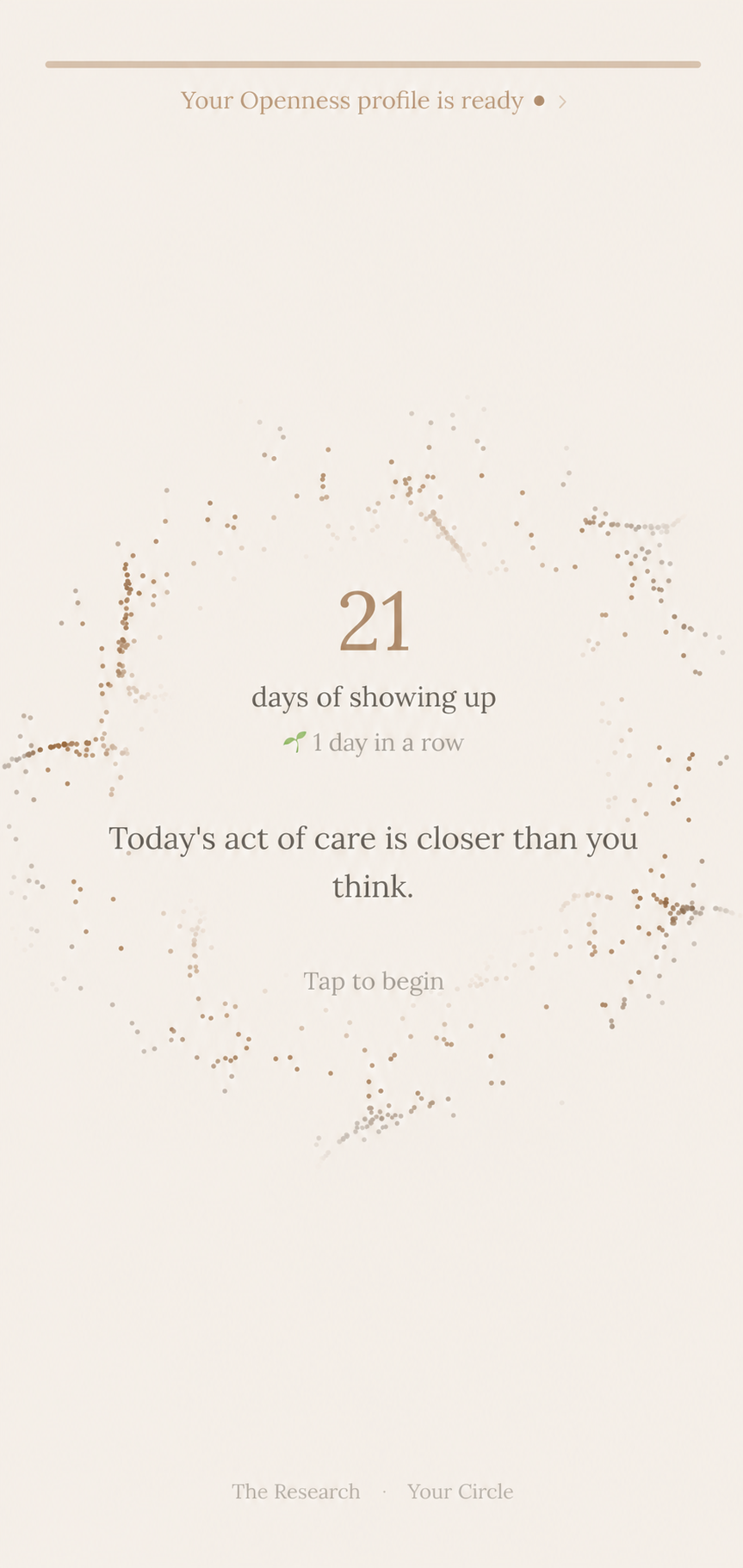
Your daily friendship loop.
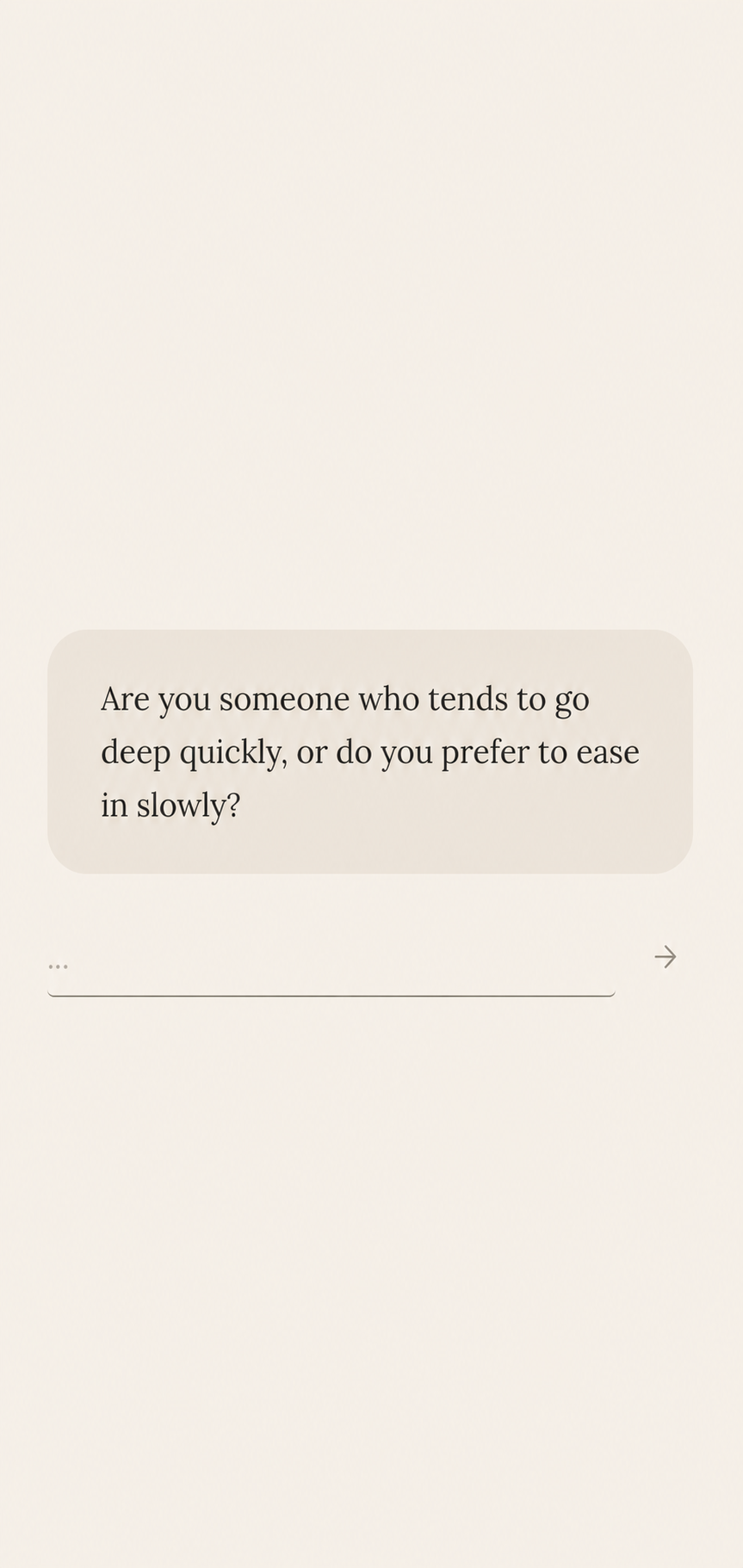
Your profile, revealed over time.
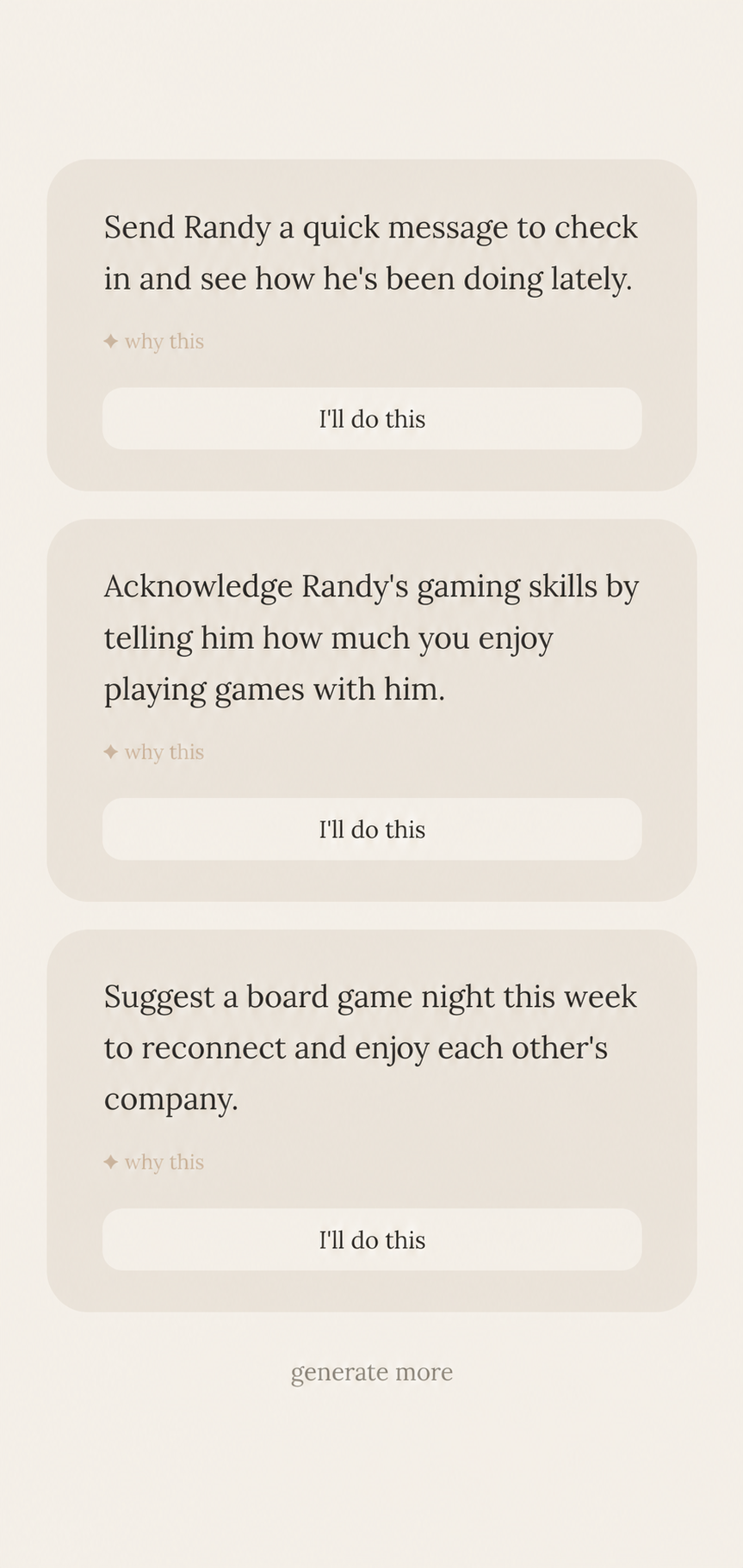
Small acts, chosen for the moment.
Fifteen dollars a year.
✦ 100% refund within 30 days. No questions asked.
One small act. Every day.
Eddie’s Friends is available now. Sign up takes about a minute. The practice is fifteen dollars a year — or twenty-five for the bundle with Done List.
- 1.Holt-Lunstad, J., Smith, T. B., & Layton, J. B. (2010). Social Relationships and Mortality Risk: A Meta-analytic Review. PLoS Medicine, 7(7).
- 2. Vaillant, G. E. (2012). Triumphs of Experience: The Men of the Harvard Grant Study. Belknap Press.
- 3. Cox, D. (2021). The State of American Friendship: Change, Challenges, and Loss. Survey Center on American Life. American Time Use Survey, BLS, 2023.
- 4. Gollwitzer, P. M. (1999). Implementation Intentions: Strong Effects of Simple Plans. American Psychologist, 54(7).
- 5.Oswald, D. L., Clark, E. M., & Kelly, C. M. (2004). Friendship Maintenance: An Analysis of Individual and Dyad Behaviors. Journal of Social and Clinical Psychology, 23(3).
- 6. Fehr, B. (1996). Friendship Processes. SAGE Publications.